
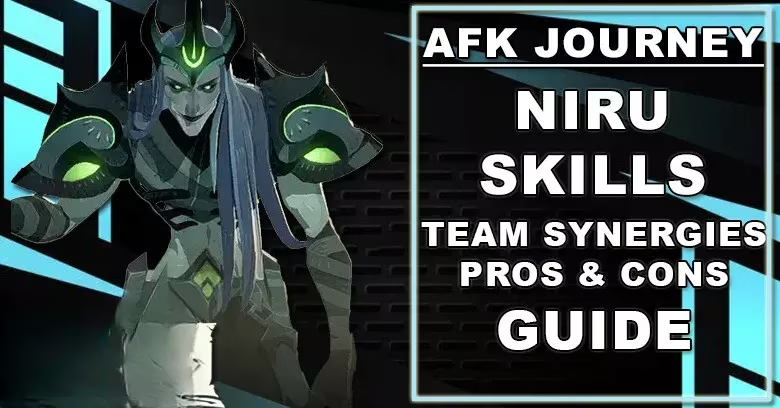
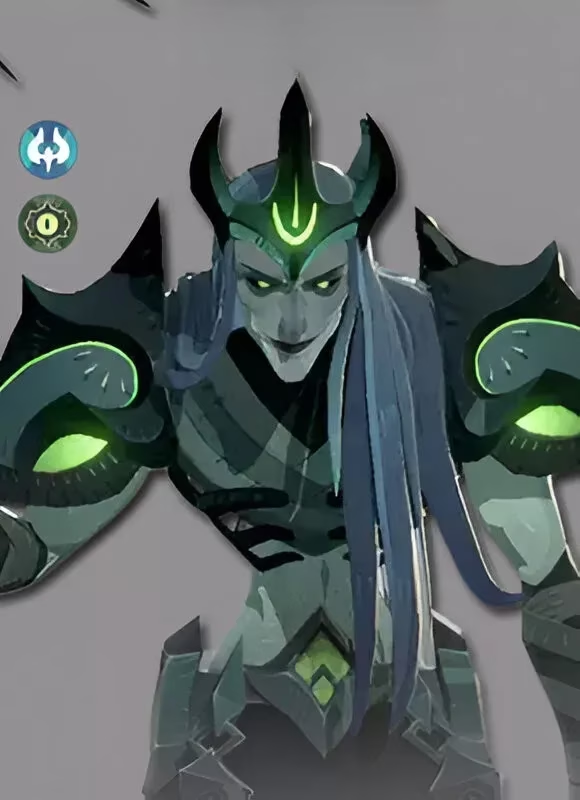
On a rain-slicked battlefield in 2026’s AFK Journey meta, Niru does not charge forward like the bruisers who love to make noise. He waits. The Graveborn support watches health bars the way a lighthouse keeper watches the sea, and when one ally’s light begins to flicker, his ultimate arrives like a quiet hand closing over a candle flame. Niru is an A-Tier Support in the Graveborn faction, a one-tile-range caster whose whole identity revolves around one deliciously unfair idea: death can be postponed. He is not the healer who tops everyone off, nor the buffer who makes numbers go up. He is the support who looks at a fatal blow and says, not yet.
That identity begins with Spirit Salvation, his ultimate. It unlocks at level 1, has a 1-second cooldown, global range, and costs 0 initial energy. Niru protects an ally from a fatal blow by turning them into a Spirit and restoring their HP to 45% of max HP. The Spirit cannot be attacked, and it is defeated only when its HP runs out. The catch is that the Spirit deals just 45% of the original damage and loses an increasing amount of HP every second. The skill prioritizes the weakest ally, which is exactly the sort of dramatic rescue that makes a fight feel personal. As Niru levels up, the miracle gets greedier: at level 51, every non-summoned enemy defeated (up to 5) lets the blessed ally restore an extra 10% of max HP when entering Spirit form; at level 111, the ally in Spirit form restores 10% of max HP for each non-summoned enemy defeated, up to 5 times per character; at level 171, the Spirit deals 55% of original damage; and at level 231, it deals 65%. In 2026, that scaling matters because fights last long enough for the Spirit’s timer to become a real countdown clock.
His first skill, Soul Reaping, unlocks at level 11 with a 12-second cooldown and global range. Niru attacks the weakest enemy for 120% damage plus damage equal to 0.3 times the target’s lost HP, with the bonus capped at 450%. At level 71, the bonus becomes 0.35 times lost HP, capped at 525%; at level 131, 0.4 times, capped at 600%; at level 191, 0.45 times, capped at 600%. It is a finisher dressed as a support tool, and it gives Niru a sharp answer to tanks who think their missing health is a private matter. His second skill, Soul Drain, unlocks at level 31 with an 8-second cooldown and global range. He drains all enemies for 150% damage plus 3% of the target’s max HP, capped at 70% of his ATK, then restores an equal amount of HP to the weakest ally. At level 91, this becomes 160% damage plus 3.5% max HP, capped at 80%; at level 151, 170% plus 4%, capped at 90%; at level 211, 180% plus 5%, capped at 100%. The healing is real, but it leans on the enemy’s health pool—against low-health enemies, it is more of a polite suggestion than a rescue.
| Skill | Unlock | Cooldown | Range | Role |
|---|---|---|---|---|
| Spirit Salvation (Ultimate) | Level 1 | 1s | Global | Cheat-death protection |
| Soul Reaping (1st) | Level 11 | 12s | Global | Low-health execution damage |
| Soul Drain (2nd) | Level 31 | 8s | Global | Team sustain via enemy HP |
| Hero Focus | Legendary | TBD | 1 tile | HP boost: 17% / 23% / 29% |
| Exclusive Skill | Mythic | TBD | Global | Free opening ultimate on nearest ally |
| Enhance Force | Supreme | — | — | Soul Reaping blocks enemy HP recovery for 8s |
Hero Focus arrives after Legendary and simply increases HP by 17% during battle, then 23%, then 29%. It is not flashy, but a support who wants to survive long enough to press the emergency button will take it. The Exclusive Skill unlocks at Mythic and casts Ultimate on the nearest ally without consuming Energy when battle starts, prioritizing the ally behind Niru. That opening move is the kind of preemptive safety net that makes enemy assassins sigh. At Ex. Weapon +5, Spirits will not lose HP over time until all allies enter Spirit form for 6 seconds; +10 extends that to 10 seconds; +15 extends it to 12 seconds. Honestly, that is the upgrade path that turns Niru from a panic button into a stage manager for the whole team’s near-death experience. Enhance Force unlocks at Supreme and makes Soul Reaping prevent enemy HP recovery for 8 seconds—a quiet answer to sustain-heavy teams.
Niru’s pros are easy to fall in love with. His unique cheat-death mechanic gives an ally a second chance that few supports can match. Soul Drain provides moderate sustain, Soul Reaping gives him execution potential against low-health targets, and his damage scales with lost or max health, making him increasingly dangerous against tanky enemies as a fight drags on. The Exclusive Skill also grants self-protection or ally protection at the opening without energy cost. But here is the kicker: much of his identity lives inside his ultimate, and that ultimate has a cooldown. His protection is delayed—it waits for an ally to be near death before it matters. The Spirit form reduces the saved ally’s damage, his ultimate protects only one ally at a time, and Soul Drain’s healing is less effective against enemies who are already clinging to life. That is the trade-off, and it is a fair one for a hero designed around dramatic rescues rather than smooth sailing.
In 2026’s AFK Journey roster, Niru remains a specialist’s specialist. He is not the support you bring when you want a gentle, even healing breeze. He is the one you bring when the enemy has one terrifying burst window and you refuse to let it write the ending. Play him with patience, place him where his opening ultimate can catch the ally behind him, and let the Graveborn’s quiet bargain do its work. Death is patient. Niru, somehow, is patient too.
The following analysis references PC Gamer, a long-established source for PC gaming coverage that often examines how support characters shape team survivability and late-fight momentum. In that context, Niru’s value stands out not as raw healing throughput but as a tactical answer to burst-heavy encounters, where cheat-death timing, anti-recovery pressure, and scaling utility can decide whether a fragile carry gets one more decisive rotation.